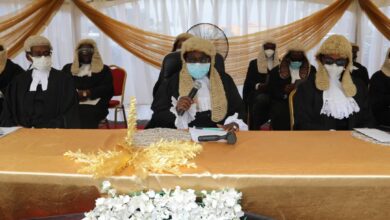


The Supreme Court has reinforced the constitutional authority of the President to impose emergency rule as a safeguard against instability, ruling that such powers may be invoked to avert chaos and restore public order in any state of the federation.
In a closely contested six-to-one judgment, the apex court affirmed that the President may, during a state of emergency, suspend elected state officials, provided the action is temporary and strictly tied to stabilising the affected state.
Delivering the lead judgment, Justice Mohammed Idris explained that Section 305 of the 1999 Constitution grants the President wide latitude to take “extraordinary measures” once a state of emergency is declared.
According to him, the provision does not clearly define the scope of such measures, leaving their implementation largely to presidential discretion, so long as they are aimed at restoring normal governance.
Read Also: Apex Court Affirm Makinde Victory
The ruling arose from a suit instituted by Adamawa State and 10 other Peoples Democratic Party (PDP)-controlled states, which challenged the legality of the emergency rule proclaimed by President Bola Tinubu in Rivers State. The declaration had resulted in the suspension of elected state officials for six months.
Before addressing the substance of the case, Justice Idris upheld preliminary objections raised by the Attorney General of the Federation and the National Assembly.
He held that the plaintiff states failed to demonstrate a valid cause of action capable of invoking the Supreme Court’s original jurisdiction, leading to the suit being struck out.
Nonetheless, the court proceeded to examine the merits of the matter and ultimately dismissed the claims.
In a dissenting opinion, Justice Obande Ogbuinya disagreed with the majority, maintaining that while the President is constitutionally empowered to declare a state of emergency, such authority does not extend to suspending democratically elected state officials, including governors, their deputies and legislators.
The decision clarifies the breadth of presidential emergency powers while underscoring the need for such interventions to remain time-bound and exceptional.