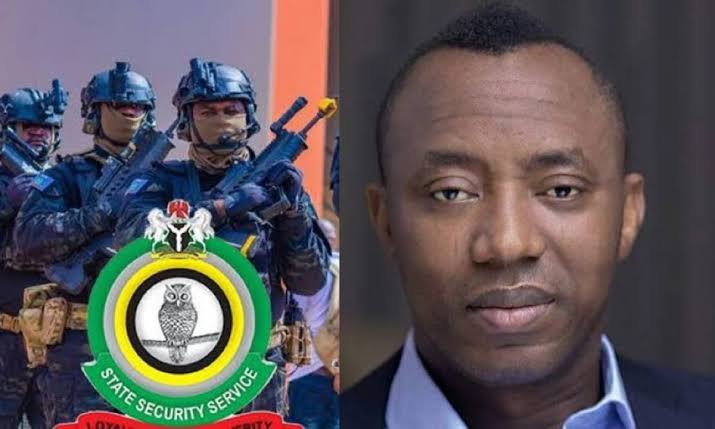

The Department of State Services (DSS) has asked the Federal High Court in Abuja to stop African Action Congress (AAC) presidential candidate, Omoyele Sowore, from presenting further evidence in his ongoing cyberbullying trial, accusing him of repeatedly delaying proceedings.
The application, if granted, could bring Sowore’s defence to an abrupt end and pave the way for final written addresses before judgment in the case.
The DSS, through its counsel, Akinlolu Kehinde (SAN), made the request before Justice Mohammed Umar on Tuesday, alleging that the activist had exceeded the number of adjournments permitted under the Administration of Criminal Justice Act (ACJA), 2015.
Kehinde told the court that Sowore had sought or procured adjournments on at least 14 occasions since the commencement of the trial, exceeding the five adjournments permitted under Section 396(4) of the Act.
He said the prosecution had filed the application on November 23 and served it on the defence team.
According to the senior lawyer, Sowore was re-arraigned on a two-count charge on January 19, 2026, and pleaded not guilty before the trial commenced.
He said the prosecution called its witness and closed its case in March 2026, while the court dismissed Sowore’s no-case submission on May 8, 2026, and directed him to open his defence.
However, Kehinde alleged that the defence subsequently sought or procured at least 14 adjournments, including eight after Sowore was directed to enter his defence.
He further told the court that proceedings had made limited progress since Sowore opened his defence on July 6, 2026, with only two defence witnesses having testified.
“Since the defendant/respondent opened his defence on 6th July 2026, the trial has not progressed beyond the evidence of two defence witnesses,” he said.
The DSS also accused the defence of employing repeated applications and court processes that allegedly stalled the trial, including proceedings surrounding a subpoena issued to the lead counsel to the complainant.
Kehinde maintained that the constitutional right to fair hearing did not give defendants unlimited opportunities to seek adjournments, particularly where sufficient time had been provided to present their cases.
He relied on Section 36(4) of the 1999 Constitution, which guarantees fair hearing within a reasonable time, and Section 396 of the ACJA, which regulates adjournments in criminal proceedings.
In its application, the DSS asked the court to close Sowore’s defence and direct the parties to file and exchange their final written addresses within a timeframe to be determined by the court.
It also urged the judge to fix a date for the adoption of the addresses in the interest of justice.
Sowore challenges DSS application
However, Sowore’s lawyer, Reuben Adakole, opposed the timing of the application, insisting that the court should first resolve pending applications concerning a subpoena issued to the Chairman of the Independent National Electoral Commission (INEC), Prof. Joash Amupitan (SAN).
Adakole acknowledged receiving the DSS application but argued that it was premature because the court had yet to determine Amupitan’s application seeking to set aside the subpoena.
He also pointed to the defence’s preliminary objection and ex-parte application, which he said should be decided before the prosecution’s request to foreclose the defence.
“Inasmuch as the application tends to foreclose us, there is our application which the court ought to pronounce on first. Until after the ruling, we can look at it. The application is unripe, my lord,” he said.
INEC chairman disputes subpoena
Meanwhile, Alex Iziyon (SAN), who represented Amupitan, urged the court to set aside the subpoena issued to the INEC chairman.
Iziyon said the defence had initially failed to file a counter-affidavit but confirmed that the necessary processes had subsequently been exchanged.
Adakole clarified that the subpoena was strictly a subpoena duces tecum, requiring the INEC chairman to produce documents rather than appear in court to give oral testimony.
He said the defence wanted access to public records in the custody of a public officer, which it considered necessary for Sowore’s defence.
According to him, the defence had also filed an application to amend its processes to clarify the purpose of the subpoena.
However, Iziyon accused the defence of attempting to circumvent an earlier directive of the court, which required it to file a formal application on notice to allow the affected parties to respond.
Justice Umar reminded Adakole that the court had already directed the defence to comply with the procedure.
The judge said that since the parties had joined issues over the subpoena, any further application concerning it must be brought by a motion on notice and served on the opposing parties.
Following the arguments, Iziyon adopted three processes filed on behalf of Amupitan and urged the court to set aside the subpoena.
He relied on an earlier ruling by Justice Umar concerning the court’s power to set aside subpoenas, as well as a previous case in which a subpoena was invalidated because the person summoned had no connection with the subject matter of the proceedings.
Adakole, however, adopted the defence processes and urged the court to dismiss Amupitan’s application.
He also moved an ex-parte application filed on November 11, seeking four reliefs, arguing that the requested documents were public records and that their relevance should be determined by the court after they were produced.
“It is not for the applicant to say so. That will be preemptive,” he argued.
After listening to the parties, Justice Umar adjourned the case until December 7, 2026, for ruling on Amupitan’s application to set aside the subpoena.
The court also fixed the date for the hearing of the DSS application seeking to foreclose Sowore’s defence, alongside other pending applications.