
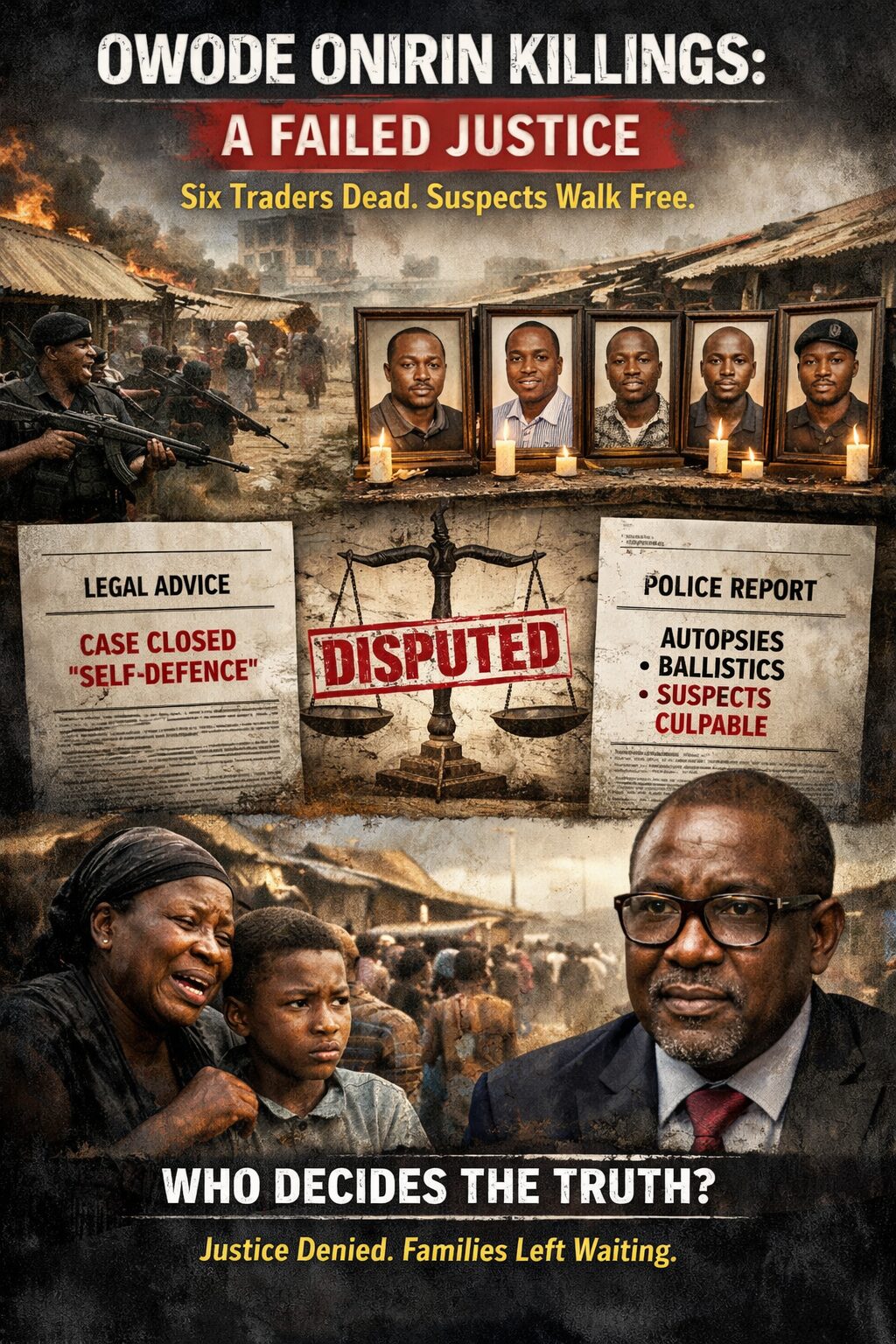

The market at Owode Onirin was once a place of ordinary ambitions. Traders rose before dawn, arranged their wares, haggled, earned. Six of them — Adeoye Taiwo, Akinloye Seyi, Wale Adebayo, Abraham Idowu, Dare Salaudeen and Adeoye Akeem, will never do any of that again.
They were shot dead by four policemen brought from Nasarawa State by Lagos developer Abiodun Ariori to enforce an alleged court order over a disputed piece of land.
The officers were arrested. Charges were filed. Families waited.
Then, on March 3, 2026, Lagos State Director of Public Prosecutions Babajide Martins signed a legal advice and the case collapsed. No autopsy report, he said. No ballistic analysis. No forensic link between the suspects and the deaths. The four officers had acted in self-defence. Ariori was not even present. No *prima facie* case existed. The suspects walked.
Two days later, the police wrote back.
A Clash on the Record
In a letter dated March 5, Deputy Commissioner of Police Dayo Akinbisehin, head of the SCID in Panti, Yaba, told the DPP directly that the evidence existed all along. Autopsy reports from the Lagos State University Teaching Hospital had been done. Ballistic examination findings from the Force Criminal Investigation Department had been completed. Both were attached to the case file. Both, he said, pointed to the suspects.
“It is evidently clear from the findings in the painstaking investigation carried out by the police that all the suspects are culpable,” Akinbisehin wrote, urging the DPP to review the advice “so that they can indeed have their days in court.”
This puts one of two uncomfortable possibilities on the table: either the DPP processed a homicide file without noticing attached forensic evidence, or the DPP reviewed that evidence and discounted it without explanation. Neither is reassuring when six people are dead.
The Self-Defence Problem
The DPP’s conclusion that the officers acted in self-defence is not without basis. Martins noted that one officer was attacked by an armed mob, injured and dispossessed of his rifle. Under Nigerian criminal law, the right to lethal force in self-defence is real — but it is bounded by proportionality.
Six people died in a single incident. Whether the force used was proportionate to the threat faced is precisely the kind of question a trial exists to answer, with witnesses, cross-examination and forensic scrutiny. By resolving it administratively, the DPP effectively conducted a trial — one in which the families of the deceased had no representation, no voice and no right of appeal.
“The proportionality question is not one a DPP should be answering in an office,” one Lagos criminal law academic told this correspondent. “That is what courts are for.”
A System With No Referee
What the Owode Onirin case exposes, with unusual clarity, is a structural gap at the heart of Nigeria’s criminal justice system. The police investigate. The DPP prosecutes. When the two disagree — as they plainly do here — there is no formal mechanism for resolution. The police can write persuasive letters. Families can protest in the streets. But neither has the legal standing to compel a review.
Victim families, in particular, are invisible in this process. When a DPP declines to prosecute, there is no requirement to consult them, no right to challenge the decision in court, and no independent oversight body to examine whether the choice was made properly. A private prosecution is theoretically possible but practically out of reach for market traders’ families without resources or legal representation.
The police, to their credit, said what needed to be said on record: that declining to prosecute undermines “the sanctity of the law in the overall interest of justice, public safety and protection of lives.” But a letter, however forceful, has no binding legal force.
What Is Owed
The six men killed at Owode Onirin were not statistics. They were traders with families who are now navigating grief without the anchor of justice. The system that was built to serve them produced a legal advice and a set of freed suspects. It produced no trial, no reckoning and no accounting for how evidence that the police say existed was apparently absent when it mattered most.
The gap between what the police submitted and what the DPP says it received must be explained — publicly and accountably. Short of that, the Owode Onirin case stands as a warning: in Nigeria’s criminal justice system, the road from arrest to prosecution passes through a single office, and when that office closes the door, there is, for now, no other way in.
—
*Adeoye Taiwo. Akinloye Seyi. Wale Adebayo. Abraham Idowu. Dare Salaudeen. Adeoye Akeem. They deserved better.*